Comparing Different Models on OpenAI
One of the first steps to building an AI app is to choose the right LLM, and there are a few aspects you need to consider to make the right decision.
Before you start, ask yourself these questions:
- How fast do you need the LLM to be?
- How smart do you want the LLM to be?
- What is your budget?
Obviously, you don't want your app to take forever to respond. It will have a significant negative impact on the user experience.
But, on the other hand, fast models are often not as "smart", and your app may require something with a decent level of accuracy, reasoning ability, and knowledge scope.
And if you want your app to profit, cost is also an important factor. Fast, smart models often cost more, so you need to ensure your app has a clear budget restriction.
In practice, balancing speed, capability, and cost is the impossible triangle when choosing a model. You will have to make sacrifices.
Let's take a look at how things work in action.
Head over to the OpenAI documentation, here you can see OpenAI's latest models.
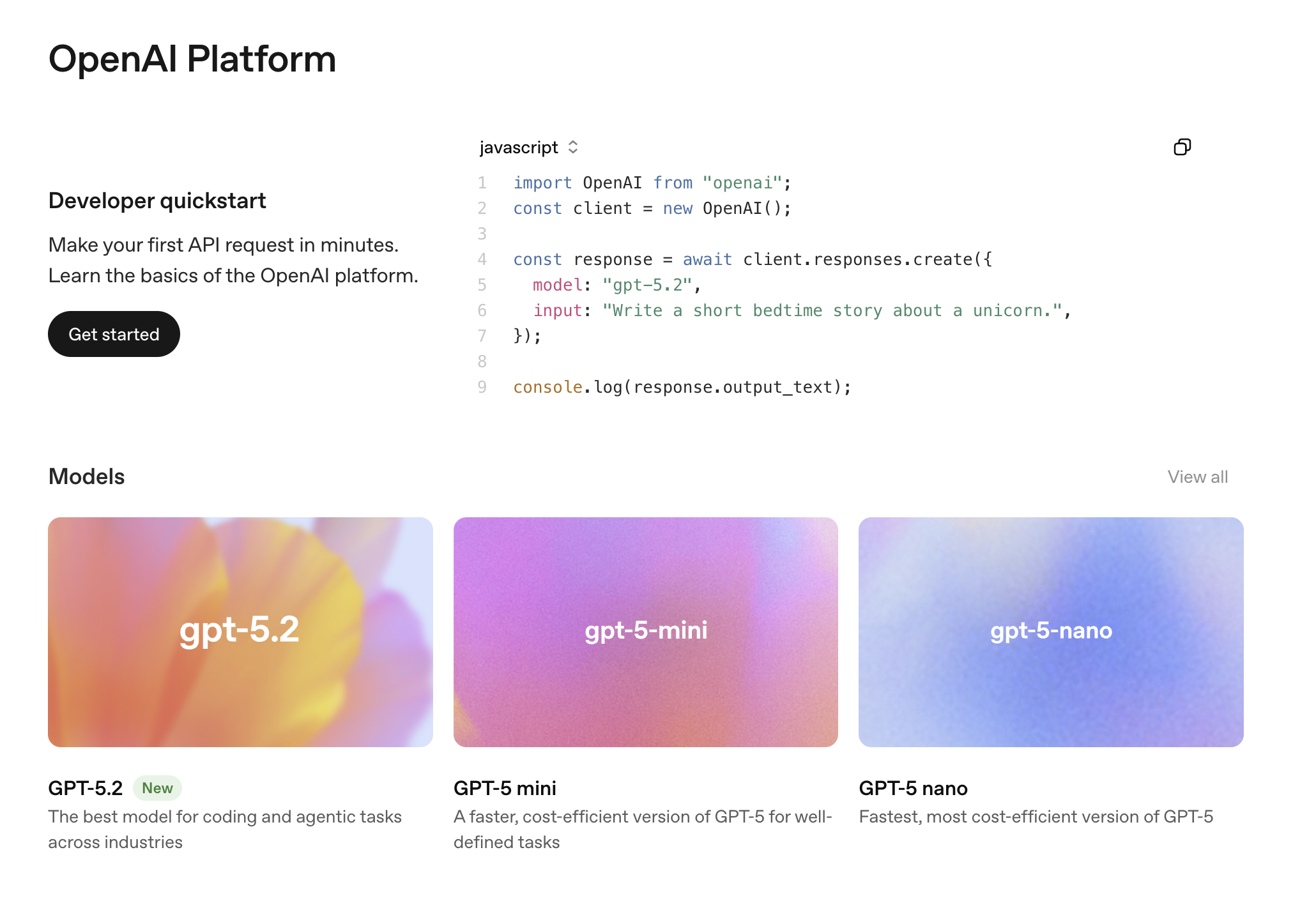
Click on a model to access its details page.
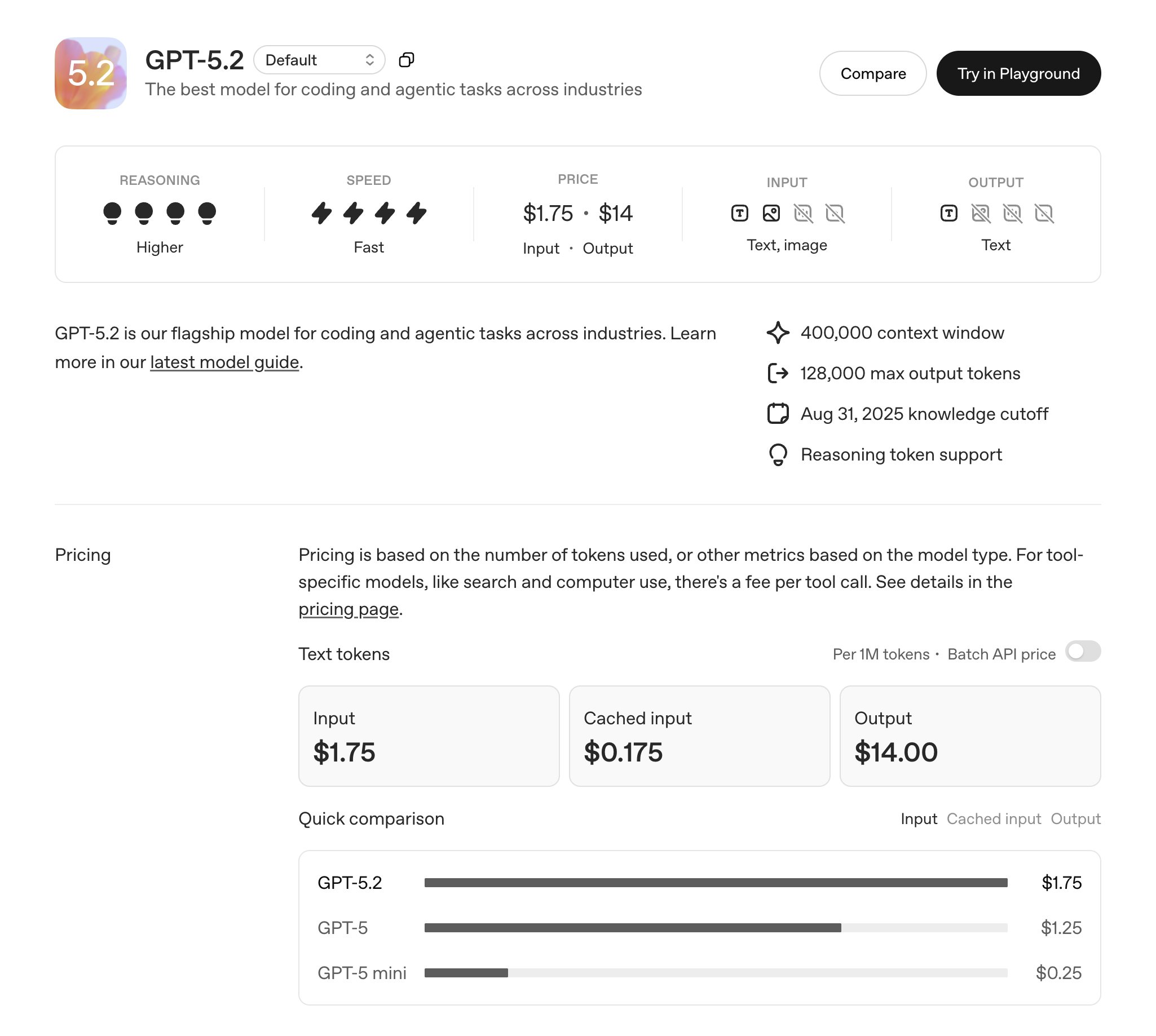
This is where you can see some of its key metrics.
For GPT-5.2, it has good reasoning ability and decent speed. However, it comes at a cost, it is one of OpenAI's more expensive models.
The price per million tokens (roughly 750,000 words) is $1.75 for inputs, and $14 for output. You should be absolutely sure you need something this powerful before opting for this model, or it's going to drain your bank account real fast.
Another thing you should pay attention to is the context window. GPT-5.2 has a context window of 400,000 tokens (roughly 300,000 words) and a maximum output of 128,000 tokens (roughly 96,000 words).
Compare OpenAI models
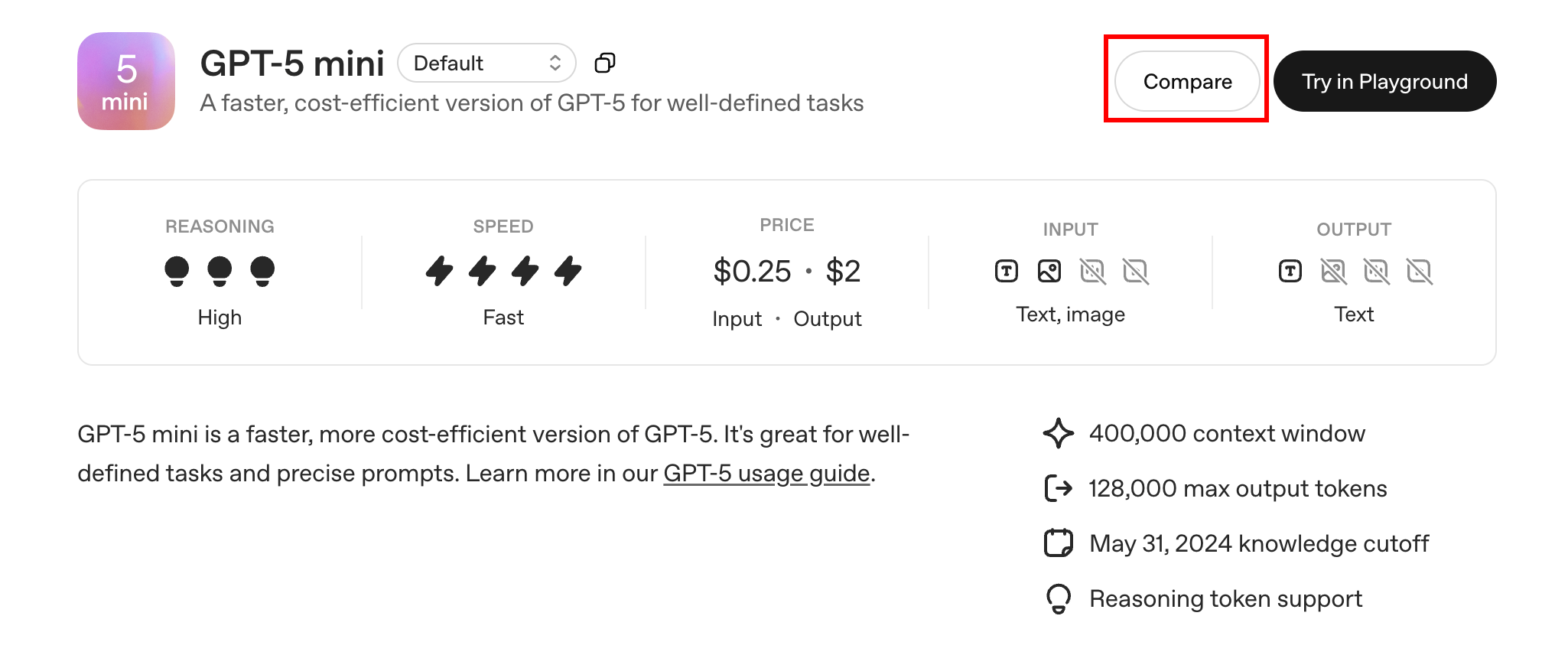
By clicking the Compare button, you can compare multiple models side by side.
As a demonstration, we are going to compare GPT-5.2, GPT-5 mini, and GPT-5 nano.
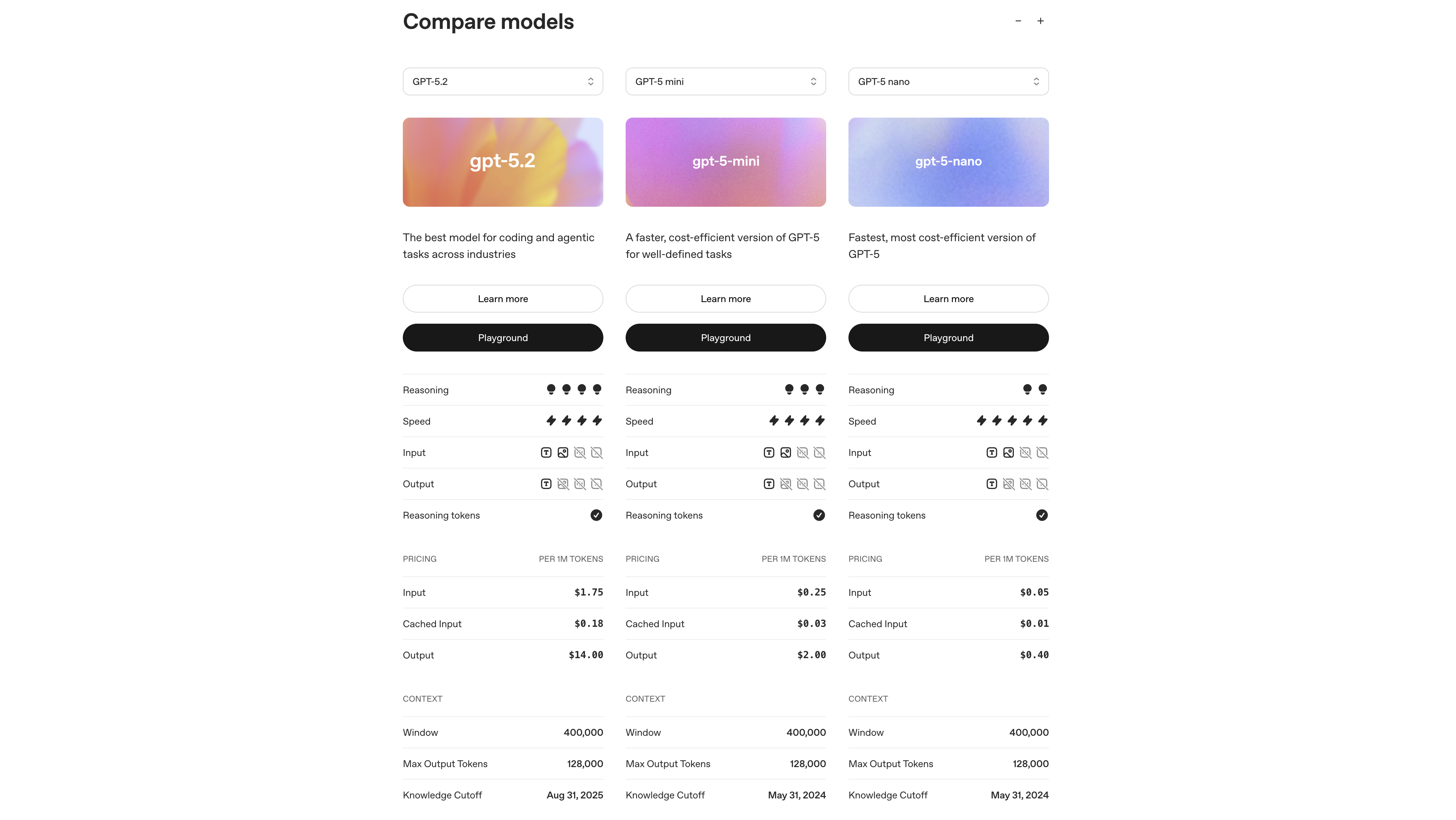
Among the three models, GPT-5.2 is the smartest. It is most suitable for professional work, such as writing technical reports, conducting data analysis, and conducting in-depth code reviews. But be careful, because it is also the most expensive.
GPT-5 nano is the fastest of the three and ideal for quick summarization and classification tasks, or any high-volume jobs that do not require reasoning. It is also much cheaper than GPT-5.2, at only $0.05 per million tokens for input, and $0.40 per million tokens for output.
GPT-5 mini is a more balanced option. It offers better reasoning than GPT-5 nano and is cheaper than GPT-5.2, making it a good option for everyday use, such as standard customer support, workflow automation, and code assistance.