
DSA Tree Structure

🌳 Trees Cheatsheet
Trees are hierarchical data structures with a root and child nodes. This cheatsheet covers binary trees, BSTs, traversals, and common operations.
✅ Tree terminology ✅ Binary trees ✅ Binary search trees ✅ DFS traversals ✅ BFS level order ✅ Common operations
#dsa #trees #binarytree #bst #traversal #interview #coding #tips
A tree is a hierarchical structure of nodes connected by edges, with one root and no cycles.
Terminology
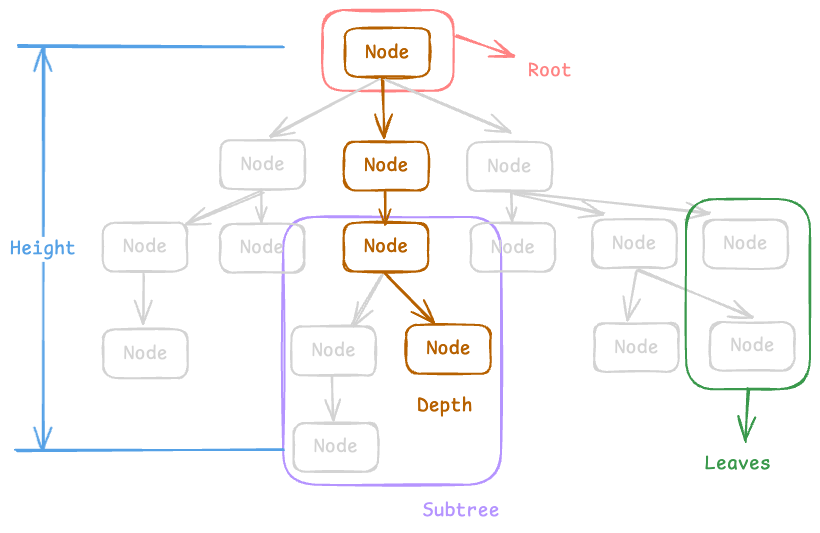
| Term | Meaning |
|---|---|
| Root | The top node (8). |
| Leaf | A node with no children (1, 4, 7, 14). |
| Height | Longest path from a node to a leaf. |
| Depth | Distance from the root to a node. |
| Subtree | A node and all its descendants. |
Binary search tree (BST)
Binary trees have at most two children per node.
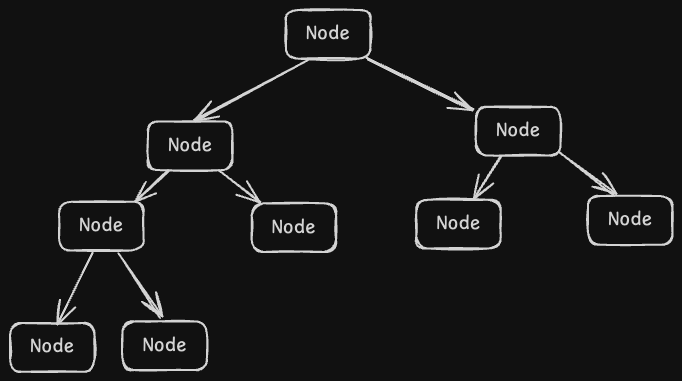
A binary tree where left children are smaller and right children are larger. Enables O(log n) search when balanced.
Every left descendant < node < every right descendant.
Depth-first traversals
Three ways to visit every node depth-first.
| Traversal | Order |
|---|---|
| Inorder | Left, node, right |
| Preorder | Node, left, right |
| Postorder | Left, right, node |
function inorder(node, result = []) {
  if (!node) return result;
  inorder(node.left, result);
  result.push(node.value);
  inorder(node.right, result);
  return result;
}function preorder(node, result = []) {
if (!node) return result;
result.push(node.value);
preorder(node.left, result);
preorder(node.right, result);
return result;
}function postorder(node, result = []) {
if (!node) return result;
postorder(node.left, result);
postorder(node.right, result);
result.push(node.value);
return result;
}Breadth-first traversal
Visit nodes level by level with a queue.
function levelOrder(root) {
  if (!root) return [];

  const result = [];
  const queue = [root];

  while (queue.length > 0) {
    const level = [];
    const size = queue.length;

    for (let i = 0; i < size; i++) {
      const node = queue.shift();
      level.push(node.value);
      if (node.left) queue.push(node.left);
      if (node.right) queue.push(node.right);
    }

    result.push(level);
  }

  return result;
}
BST operations
Search a BST:
// Find a node with the target value
function search(node, target) {
  // Base case: not found, or found it
  if (!node || node.value === target) return node;

  // Go left if smaller, right if larger
  return target < node.value
    ? search(node.left, target)
    : search(node.right, target);
}
Insert at the correct leaf position:
// Insert a value into the BST
function insert(node, value) {
  // Found the empty spot, create the node
  if (!node) return { value, left: null, right: null };

  // Go left if smaller, right if larger
  if (value < node.value) node.left = insert(node.left, value);
  else node.right = insert(node.right, value);

  return node;
}
Delete a node while keeping the BST property:
// Delete a value from the BST
function remove(node, value) {
  if (!node) return null;

  // Find the node to delete
  if (value < node.value) {
    node.left = remove(node.left, value);
    return node;
  }
  if (value > node.value) {
    node.right = remove(node.right, value);
    return node;
  }

  // Case 1: no children, just remove it
  if (!node.left && !node.right) return null;

  // Case 2: one child, replace with the child
  if (!node.left) return node.right;
  if (!node.right) return node.left;

  // Case 3: two children, replace with the inorder successor
  // (smallest value in the right subtree)
  let successor = node.right;
  while (successor.left) successor = successor.left;

  node.value = successor.value;
  node.right = remove(node.right, successor.value);
  return node;
}
Full-Stack AI Developer Roadmap
From HTML & CSS to working with AI models, all in one structured roadmap.