
DSA Linked Lists

🔗 Linked Lists Cheatsheet
Linked lists store elements in nodes connected by pointers. This cheatsheet covers structure, traversal, reversal, and classic pointer techniques.
✅ Node structure ✅ Traversal ✅ Reversal ✅ Fast and slow pointers ✅ Cycle detection ✅ Common operations
#dsa #linkedlist #pointers #interview #coding #tips
A linked list is a chain of nodes where each node holds a value and a pointer to the next node.

Structure
class ListNode {
  constructor(value, next = null) {
    this.value = value;
    this.next = next;
  }
}
Build: 1 → 2 → 3
const head = new ListNode(1, new ListNode(2, new ListNode(3)));Traversal
Walk the list by following next pointers:
function traverse(head) {
  let current = head;

  // Move to the next node until next is null
  while (current) {
    console.log(current.value);
    current = current.next;
  }
}
Find the length of the list:
function length(head) {
  let count = 0;
  let current = head;

  while (current) {
    count++;
    current = current.next;
  }

  return count;
}
Add a node
Insert at the head
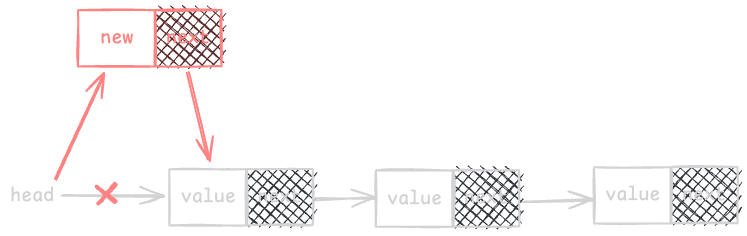
O(1) run time.
// Add a node at the beginning
function prepend(head, value) {
  // Point the new node at the current head
  const node = new ListNode(value, head);

  // The new node becomes the head
  return node;
}
Insert at the tail
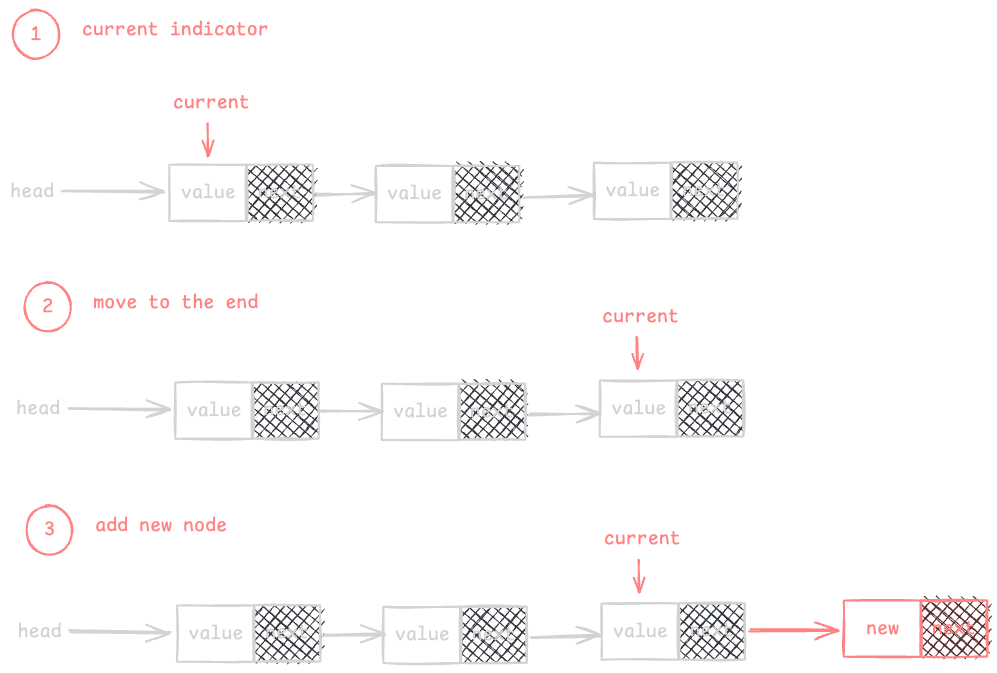
O(n) run time without a tail pointer.
function append(head, value) {
  // Create a new node
  const node = new ListNode(value);

  // If empty list, the new node is the head
  if (!head) return node;

  // If not, walk to the last node
  let current = head;
  while (current.next) {
    current = current.next;
  }

  // Link the last node to the new node
  current.next = node;
  return head;
}
Insert at a specific index
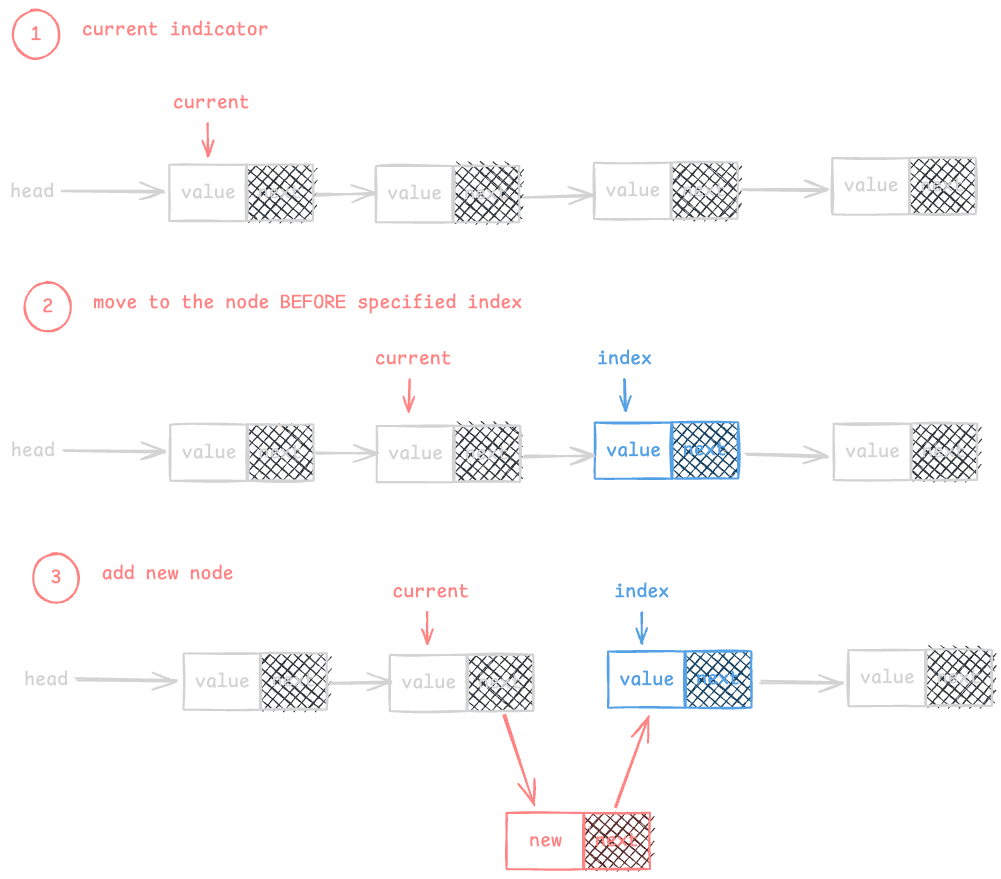
function insertAt(head, value, index) {
  // Index 0 means prepend
  if (index === 0) return new ListNode(value, head);

  // Walk to the node before the target index
  let current = head;
  for (let i = 0; i < index - 1 && current; i++) {
    current = current.next;
  }

  // Index out of bounds
  if (!current) return head;

  // Add new node after current, and link it to the current.next
  current.next = new ListNode(value, current.next);
  return head;
}
Remove a node
Remove by value
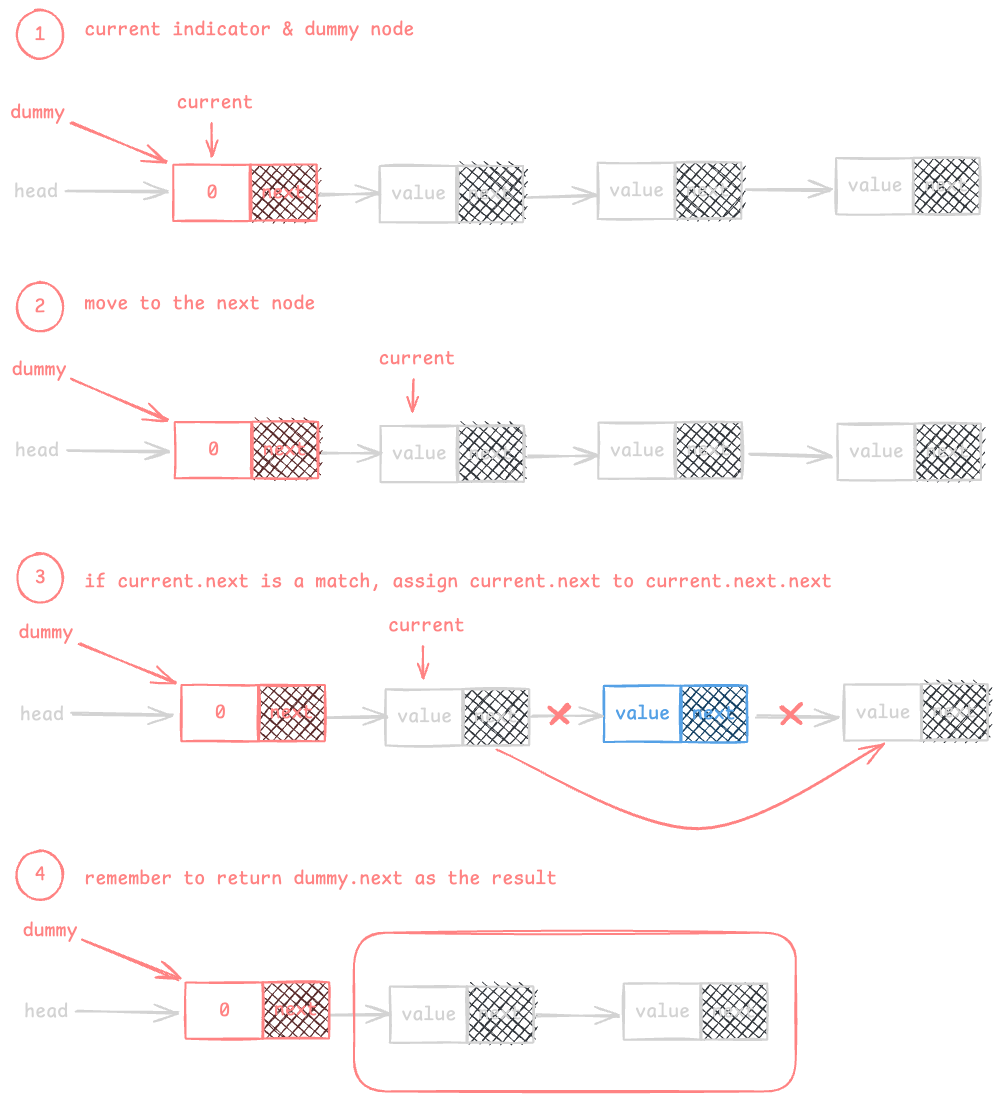
function remove(head, value) {
  // Dummy node simplifies removing the head
  const dummy = new ListNode(0, head);
  let current = dummy;

  while (current.next) {
    if (current.next.value === value) {
      // If the next node matches, skip over it
      current.next = current.next.next;
    } else {
      // Otherwise, move to the next node
      current = current.next;
    }
  }

  return dummy.next;
}
Remove at a specific index
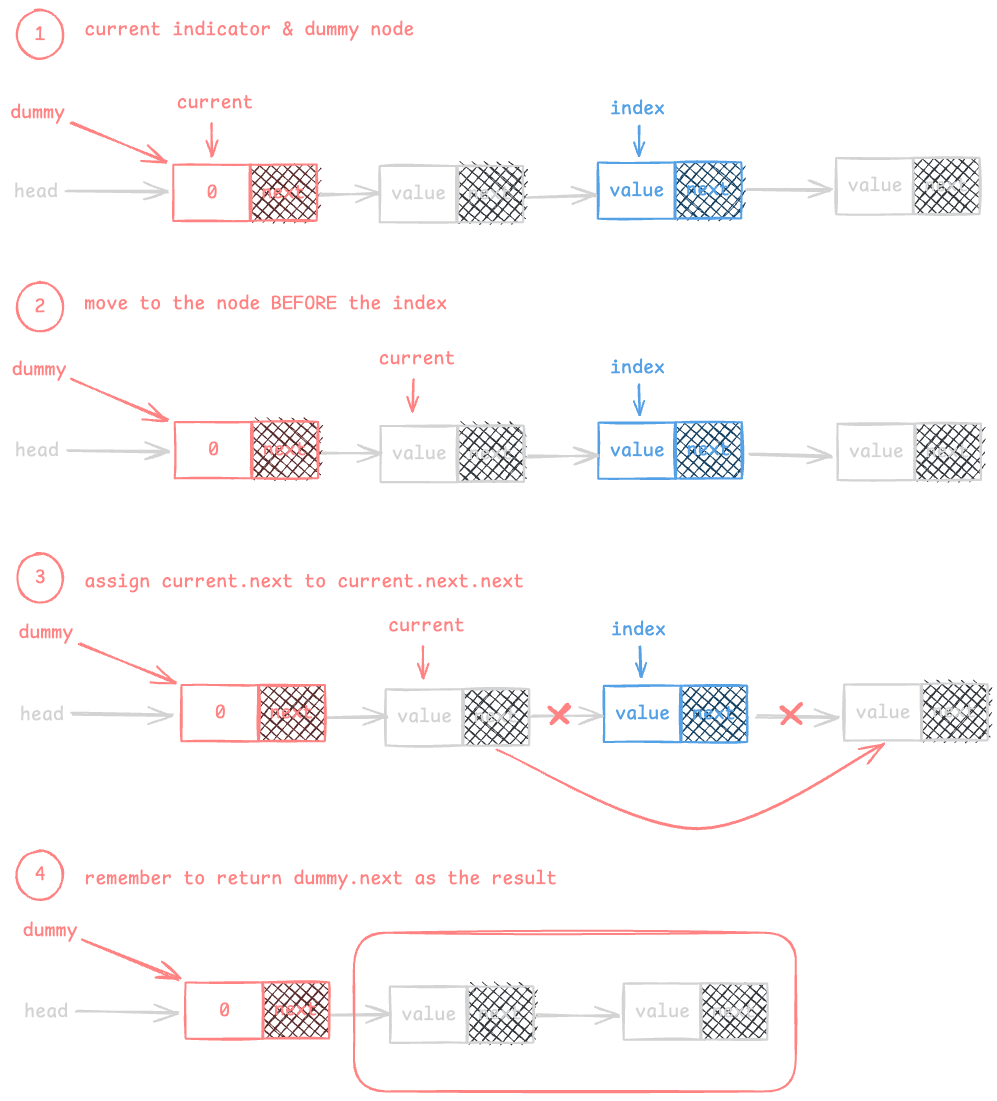
// Remove the node at the given index
function removeAt(head, index) {
  const dummy = new ListNode(0, head);
  let current = dummy;

  // Walk to the node before the target index
  for (let i = 0; i < index && current.next; i++) {
    current = current.next;
  }

  // Skip over the target node, if it exists
  if (current.next) {
    current.next = current.next.next;
  }

  return dummy.next;
}
Reversal
Reversing a list is a classic interview problem. Reverse a list by redirecting each pointer.
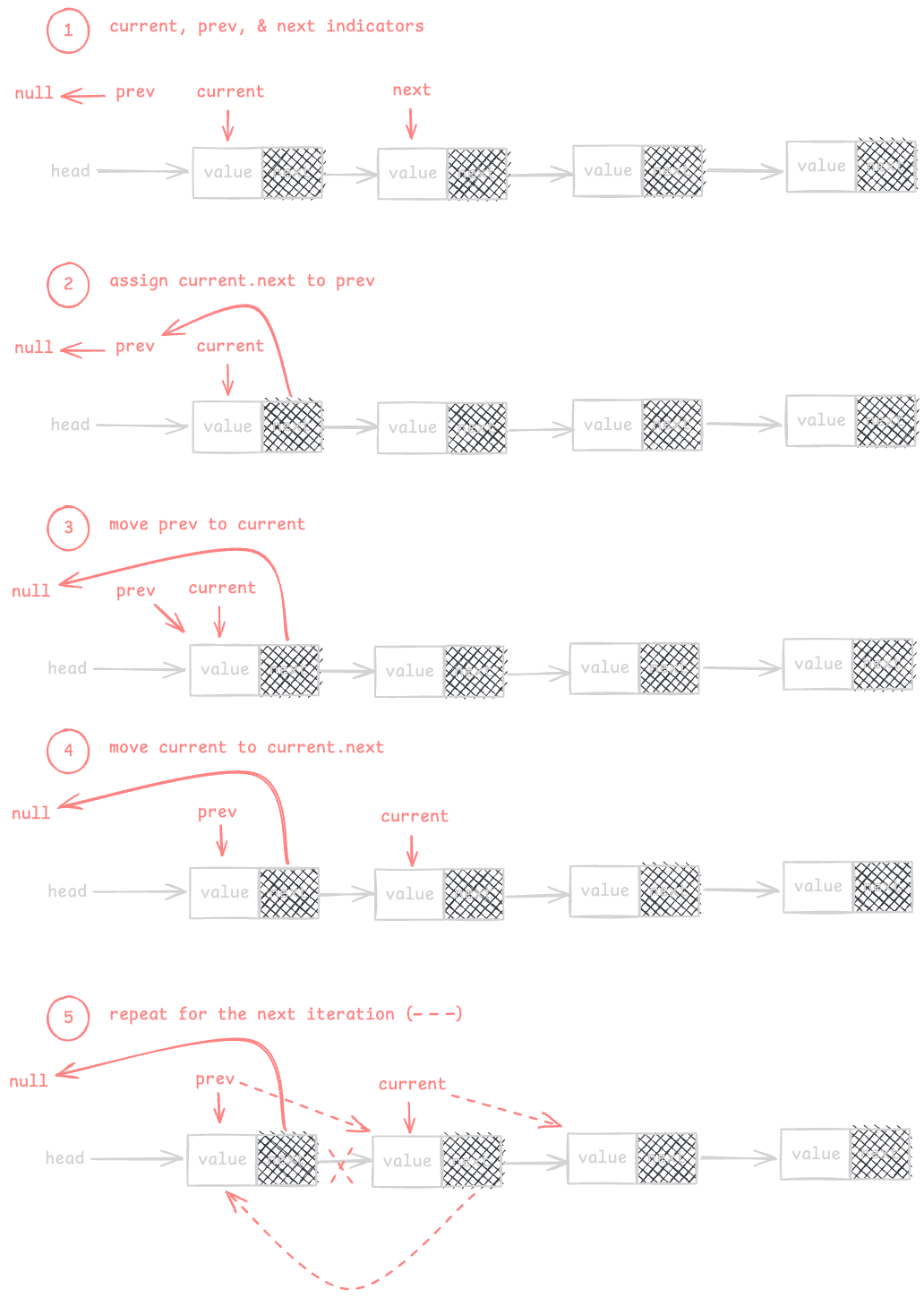
function reverse(head) {
  let prev = null;
  let current = head;

  // While current is not null
  while (current) {
    // Save the next node before overwriting the pointer
    const next = current.next;

    // Reverse the pointer
    current.next = prev;

    // Move prev to current
    prev = current;

    // Move current to next
    current = next;
  }

  return prev; // new head
}
Fast and slow pointers
Many list related problems can be solved with two pointers moving at different speeds.
Find the middle node
Fast pointer moves two steps at a time, slow pointer moves one step.
When fast reaches the end, slow is at the middle.
function middle(head) {
  let slow = head;
  let fast = head;

  while (fast && fast.next) {
    slow = slow.next;
    fast = fast.next.next;
  }

  return slow; // slow is at the middle
}
Detect a cycle (Floyd's algorithm)
If there's a cycle, fast eventually overlaps with slow.
function hasCycle(head) {
  let slow = head;
  let fast = head;

  while (fast && fast.next) {
    slow = slow.next;
    fast = fast.next.next;
    if (slow === fast) return true;
  }

  return false;
}
Linked list vs array
| Operation | Array | Linked list |
|---|---|---|
| Access by index | O(1) | O(n) |
| Search | O(n) | O(n) |
| Insert at start | O(n) | O(1) |
| Insert at end | O(1) amortized | O(n) |
| Delete | O(n) | O(1) (with pointer) |
Full-Stack AI Developer Roadmap
From HTML & CSS to working with AI models, all in one structured roadmap.